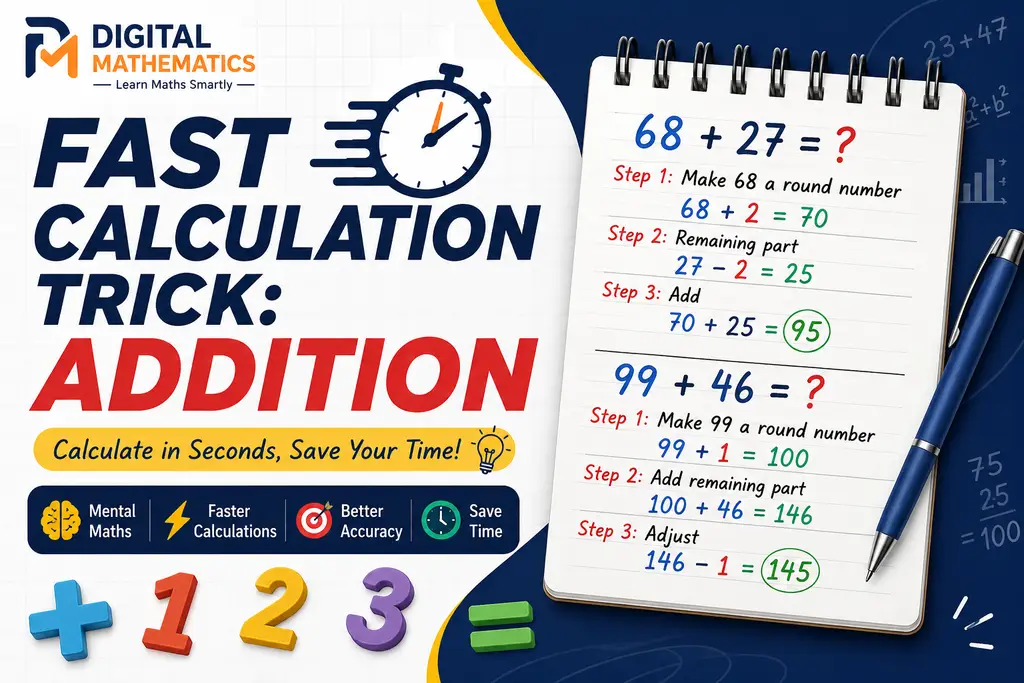
Fast Calculation Trick: Addition — Amazing Tricks to Calculate Faster
Introduction
Addition is one of the most basic operations in mathematics, but calculating large numbers quickly can sometimes take time. Students often depend on traditional column addition even when a simpler mental method can give the answer much faster.
The good news is that you can improve your calculation speed by learning a few simple techniques. These methods are useful for school mathematics, competitive examinations, daily calculations, and mental maths practice.
In this article, Digital Mathematics explains some practical fast calculation tricks for addition that students can learn and use regularly.
The goal is not simply to calculate quickly. The goal is to understand numbers so well that your brain can recognize an easier calculation method automatically.
What Is a Fast Calculation Trick for Addition?
A fast calculation trick for addition is a simple mathematical technique that helps you find the sum of numbers without following lengthy traditional steps.
For example:
48 + 27
Instead of adding directly, break 27 into 20 + 7:
48 + 20 = 68
68 + 7 = 75
This method is simple, but with practice, your mental calculation becomes much faster.

1. Break Numbers into Tens and Ones
One of the easiest addition tricks is to separate a number into tens and ones.
Consider:
56 + 32
Break 32 into 30 + 2.
56 + 30 = 86
86 + 2 = 88
Therefore:
56 + 32 = 88
This technique is especially useful for beginners because it makes the calculation easier to visualize.
Another Example
73 + 46
73 + 40 = 113
113 + 6 = 119
So:
73 + 46 = 119
With regular practice, you may perform these steps mentally without writing them down.
2. Make a Round Number
Another powerful method is to change one number temporarily so that you can create a multiple of 10, 100, or 1000.
For example:
49 + 36
49 is close to 50.
Take 1 from 36 and give it to 49:
49 + 1 = 50
36 − 1 = 35
Now:
50 + 35 = 85
Therefore:
49 + 36 = 85
This method is known as compensation. It is one of the most useful mental addition techniques.
Example
98 + 27
Increase 98 by 2:
98 + 2 = 100
Reduce 27 by 2:
27 − 2 = 25
Now:
100 + 25 = 125
So:
98 + 27 = 125
3. Add from Left to Right
Traditional addition often encourages students to begin from the right side. For mental calculation, however, adding from left to right can be very convenient.
Consider:
324 + 215
First add the hundreds:
300 + 200 = 500
Then the tens:
20 + 10 = 30
Then the ones:
4 + 5 = 9
Therefore:
500 + 30 + 9 = 539
So:
324 + 215 = 539
This technique can help you develop stronger number sense. Fast Calculation Trick: Addition is always easy to solve numbers solution.
4. Add Hundreds, Tens and Ones Separately
For larger numbers, separate the numbers according to place value.
Example:
456 + 327
Hundreds:
400 + 300 = 700
Tens:
50 + 20 = 70
Ones:
6 + 7 = 13
Now combine:
700 + 70 + 13 = 783
Therefore:
456 + 327 = 783
This technique is particularly useful when students are learning place value. For “Fast Calculation Trick: Addition” you can contact us.
5. Use Compensation for Numbers Near 100
Numbers close to 100 can often be added extremely quickly.
Example:
97 + 58
97 needs 3 to become 100.
Take 3 from 58:
58 − 3 = 55
Now:
100 + 55 = 155
Therefore:
97 + 58 = 155
Try another:
96 + 47
96 needs 4 to become 100.
47 − 4 = 43
So:
100 + 43 = 143
Answer:
96 + 47 = 143
6. Add Numbers in Pairs
When several numbers are given, look for combinations that make round numbers.
For example:
25 + 15 + 75 + 85
Instead of adding from left to right, create convenient pairs:
25 + 75 = 100
15 + 85 = 100
Therefore:
100 + 100 = 200
This is much faster than performing four separate additions.
Another Example
38 + 62 + 27 + 73
38 + 62 = 100
27 + 73 = 100
Therefore:
100 + 100 = 200
The important skill here is recognizing complementary numbers.
7. Use the Complement of 10
Numbers that add to 10 are very useful in mental maths.
Some common pairs are:
1 + 9 = 10
2 + 8 = 10
3 + 7 = 10
4 + 6 = 10
5 + 5 = 10
Suppose you need to calculate:
27 + 8
27 needs 3 to reach 30.
Break 8 into 3 + 5:
27 + 3 = 30
30 + 5 = 35
Therefore:
27 + 8 = 35
This method becomes extremely fast with practice.
8. Addition of Consecutive Numbers
Consecutive numbers are numbers that follow one another, such as:
21, 22, 23, 24 and 25.
Instead of adding each number individually, use the average method.
For example:
21 + 22 + 23 + 24 + 25
There are 5 numbers.
The middle number is 23.
So:
5 × 23 = 115
Therefore:
21 + 22 + 23 + 24 + 25 = 115
For consecutive numbers, the sum can often be found using:
Number of terms × Average
This can save considerable calculation time.
9. Addition of Even Consecutive Numbers
Consider:
22 + 24 + 26 + 28 + 30
There are 5 numbers.
The average is:
(22 + 30) ÷ 2 = 26
Therefore:
5 × 26 = 130
So:
22 + 24 + 26 + 28 + 30 = 130
This method is especially useful when working with sequences and arithmetic progressions.
10. Addition of Large Numbers
Large numbers may look difficult, but place-value separation makes them easier.
Example:
4,325 + 2,614
Break them into parts:
4,000 + 2,000 = 6,000
300 + 600 = 900
20 + 10 = 30
5 + 4 = 9
Now combine:
6,000 + 900 + 30 + 9 = 6,939
Therefore:
4,325 + 2,614 = 6,939
Once you become comfortable with place values, large-number addition becomes much easier.
11. Add 99, 999 and 9,999 Quickly
Numbers just below powers of 10 can be handled using compensation.
Example:
456 + 99
Instead of adding 99 directly:
456 + 100 = 556
Then subtract 1:
556 − 1 = 555
Therefore:
456 + 99 = 555
Similarly:
2,345 + 999
2,345 + 1,000 = 3,345
3,345 − 1 = 3,344
So:
2,345 + 999 = 3,344
This is one of the most useful techniques for fast mental calculation.
12. Practice with a 5-Minute Calculation Routine
Learning a trick is only the first step. Speed develops through regular practice.
Spend just five minutes every day solving mental addition problems.
Level 1
Practice two-digit numbers:
27 + 35
48 + 26
57 + 38
69 + 24
Level 2
Practice three-digit numbers:
125 + 236
348 + 275
426 + 189
567 + 234
Level 3
Practice mixed calculations:
99 + 48
197 + 36
398 + 102
999 + 456
Try to calculate mentally before writing the answer.
Why Learn Fast Calculation Tricks?
Fast calculation is not about rushing through mathematics. It is about choosing an efficient method.
These techniques can help students:
-
- Improve mental maths skills
-
- Increase calculation speed
-
- Reduce unnecessary written steps
-
- Develop number sense
-
- Improve confidence in mathematics
-
- Save time during examinations
-
- Make everyday calculations easier
Students preparing for school examinations and competitive tests can particularly benefit from regular mental-maths practice.
Common Mistakes to Avoid
While learning fast calculation methods, accuracy should always come first.
1. Calculating Too Quickly
Speed without accuracy can lead to mistakes. First learn the method correctly, then gradually increase your speed.
2. Ignoring Place Value
When adding large numbers, always understand thousands, hundreds, tens and ones.
3. Forgetting Compensation
If you add something to one number to make it round, remember to subtract the same amount from the other number.
4. Not Checking the Answer
After solving a difficult calculation, perform a quick estimation to see whether the answer is reasonable.
For example:
398 + 201
You can estimate:
400 + 200 = 600
Therefore, an answer close to 600 is expected. The exact answer is:
599
Fast Calculation Trick: Addition — Practice Challenge
Try solving these without a calculator:
-
- 48 + 27 = ?
-
- 97 + 36 = ?
-
- 125 + 275 = ?
-
- 456 + 244 = ?
-
- 999 + 125 = ?
-
- 38 + 62 + 45 + 55 = ?
-
- 21 + 22 + 23 + 24 + 25 = ?
-
- 96 + 48 = ?
-
- 1,245 + 755 = ?
-
- 2,398 + 602 = ?
Answers
-
- 75
-
- 133
-
- 400
-
- 700
-
- 1,124
-
- 200
-
- 115
-
- 144
-
- 2,000
-
- 3,000
Try to solve these again after a few days and see whether your calculation time improves.
How Digital Mathematics Can Help You
Digital Mathematics focuses on making mathematics easier, practical and interesting for students.
Instead of memorizing complicated procedures, students can learn how numbers work and how mathematical patterns can simplify calculations.
Whether you are studying school mathematics, preparing for examinations, or simply trying to improve your mental calculation ability, practicing small techniques every day can make a significant difference.
Remember: fast calculation is a skill, and skills improve through practice.
Start with one addition trick today. Master it, practice it, and then move to the next one.
Frequently Asked Questions (FAQs)
What is the best fast calculation trick for addition?
Breaking numbers into tens and ones and using compensation are two of the easiest techniques. For example, 98 + 27 can be converted into 100 + 25 = 125.
How can I improve my addition speed?
Practice mental addition for 5–10 minutes every day. Start with two-digit numbers and gradually move to three- and four-digit calculations.
Is mental maths useful for students?
Yes. Mental maths can improve number sense, calculation confidence and speed. It can also help students save time during examinations.
How can I add numbers near 100 quickly?
Use compensation. For example, for 97 + 58, move 3 from 58 to 97. This gives 100 + 55 = 155.
What is the easiest way to add consecutive numbers?
For a sequence of consecutive numbers, multiply the number of terms by their average. For example, 21 + 22 + 23 + 24 + 25 = 5 × 23 = 115.
Can these tricks be used in competitive exams?
Yes. Mental calculation techniques can be useful wherever quick and accurate arithmetic is required. However, students should always follow the rules and methods permitted in their particular examination.
How long does it take to learn fast addition?
Basic techniques can be understood quickly, but calculation speed develops through regular practice. A few minutes of daily practice can gradually improve your confidence and efficiency.
Final Takeaway
The easiest way to become better at addition is not to memorize hundreds of tricks. Instead, learn how to recognize number patterns.
Use:
Break → Round → Compensate → Combine → Check
For example:
98 + 27
Round 98 to 100:
98 + 2 = 100
Take 2 from 27:
27 − 2 = 25
Therefore:
100 + 25 = 125
Simple techniques like this can turn lengthy calculations into quick mental steps.
Keep practicing, stay accurate, and make mathematics a daily habit with Digital Mathematics.
SEO FEAT / On-Page SEO Guide
Primary Keyword: fast calculation trick addition
Secondary Keywords:
- fast addition tricks
- addition calculation tricks
- mental maths addition tricks
- quick addition methods
- maths calculation tricks
- addition shortcuts
- mental calculation tricks
- fast maths tricks
- addition tricks for students
- quick calculation tricks
Suggested SEO Title:
Fast Calculation Trick: Addition | 12 Easy Mental Maths Tricks
Suggested Meta Description:
Learn fast calculation trick addition methods with easy examples. Discover mental maths, addition shortcuts, compensation tricks and practice questions with Digital Mathematics.
Suggested URL:/fast-calculation-trick-addition/
Suggested H1:
Fast Calculation Trick: Addition
Suggested H2 Headings:
- What Is a Fast Calculation Trick for Addition?
- Break Numbers into Tens and Ones
- Make a Round Number
- Add from Left to Right
- Use Compensation for Numbers Near 100
- Addition of Consecutive Numbers
- Addition of Large Numbers
- Practice Challenge
- Frequently Asked Questions
Keyword Density Recommendation:
Keep the primary keyword around 1% or lower, and use related keywords naturally. Avoid forcing the keyword into every paragraph. Search engines generally value useful, readable content more than repetitive keyword placement.
Image SEO Suggestions:
- Image Alt Text:
fast calculation trick addition - Image Title:
Fast Calculation Trick for Addition - Featured Image File Name:
fast-calculation-trick-addition.jpg
Internal Linking Ideas:
- Maths Short Tricks
- Fast Multiplication Tricks
- CBSE Mathematics Tips
- Mental Maths Practice
- Class 9 Maths Tips
- Class 10 Maths Preparation
CTA for the Blog:
Want to learn more easy mathematics tricks? Explore Digital Mathematics for practical maths tips, shortcuts, examples and exam-focused learning.
SEO Note: The article is designed to be reader-friendly and search-engine optimized, but keyword density should remain natural rather than artificially repeated.
To know more subscribe our youtube channel